


Story
奥山 純一
Junichi Okuyama
奥山 純一
Junichi Okuyama
About the Project
When I first encountered fragments of broken ceramics, they appeared to me as human beings.
When I say this, many people may wonder what I mean. Even I sometimes feel that it sounds strange. Yet after many years working in the field of welfare, supporting employment for people with disabilities, the fragments I saw unmistakably overlapped, in my eyes, with the presence of people with disabilities.
Kutani ware, produced in southern Ishikawa Prefecture where our base is located, is widely known throughout Japan for its vivid and richly expressive colors, often referred to as the “Kutani Five Colors.” But did you know that approximately ten percent of production is discarded as “out of standard” during the manufacturing process?
Not only fragments shattered beyond use, but even pieces with minor blemishes—imperfections that cause no inconvenience in everyday use—are excluded from official products and labeled as out of standard. This reality overlapped, for me, with the way people are pushed outside the framework of what humans have arbitrarily defined as “able-bodied.”
Who, after all, decides what is “out of standard”?
Are things that fall outside or are left aside truly without value, or of lesser worth? If we look again from a slightly different angle, might an entirely different landscape emerge?
On January 1, 2024, the Noto Peninsula Earthquake struck all of Ishikawa Prefecture. Nearly five tons of ceramic fragments, shattered by the violent shaking of the earth, came into our hands. Since then, we have continued to confront these fragments, looking at them and joining them together. The act of connecting irregular pieces is both difficult and hopeful.
Joining “Fragments” to “Fragments”: What CACL Does
At CACL, we collect craft objects and ceramic fragments that would otherwise be discarded as defective or waste, and repurpose them into artworks, products, and architectural materials. Not only Kutani ware but many traditional crafts have developed systems of mass production so they can be easily used in shops and households across the country, and within this history, approximately ten percent of production has come to be classified as out of standard.
We continue to challenge ourselves to discover and pursue new value in what was originally meant to be thrown away.
One of our representative methods is to join fragments of Kutani ware and Suzu ware—both traditional crafts of Ishikawa—using kintsugi techniques associated with Wajima lacquerware from Noto.
Another important mission of the project is to create places and opportunities where people with disabilities can work in ways that reflect who they are. They participate in processes such as sorting and polishing collected ceramic fragments, and applying transfer designs—attaching patterns to ceramic surfaces.
We produce a range of works, from art pieces to practical objects such as plates, vessels, and chairs. At our workshop in Nomi City, Ishikawa, which serves as the project’s base, we hold workshops where participants from within and outside the region create chopstick rests using Kutani ceramic fragments.
Recently, the potential of these materials as architectural resources has also gained attention. For example, in the production of benches installed in a space inside Tamagawa Takashimaya S.C., designed by architect Yuko Nagayama, we had the opportunity to provide out-of-standard Kutani ware as aggregate material.
The white porcelain and vivid colors of Kutani ware, the simple gray of Suzu ware, and the texture of lacquer in Wajima-nuri. The fusion of different techniques and materials that once existed separately across Ishikawa is both beautiful and fresh. By joining fragment to fragment, we hope to become a point of departure for carrying these techniques into the future. This is what we continue to reflect on in our daily work.
One Year After the Noto Peninsula Earthquake — In the Intertwining of Chance and Necessity
It may be said that this series of activities has moved like a vortex within an intertwining of chance and necessity. Needless to say, this is inseparable from the Noto Peninsula Earthquake of January 1, 2024, which recorded a maximum seismic intensity of 7.
About half a year earlier, in early summer 2023, when I first encountered fragments of Kutani ceramics, I experienced the strong inspiration described at the beginning. However, I was still considering and experimenting with how to give form to an attempt to question what is defined as “out of standard.” Seeking first to understand Kutani ware, I traveled to Taiwan and China to introduce it, and conducted experiments joining ceramic fragments with adhesives and various materials. I continued through trial and error.
At a time when I had not yet found a breakthrough, the earthquake occurred, and within days nearly five tons of Kutani ceramic fragments were brought all at once to my workshop.
As I looked at the mountain of fragments created in an instant by the shaking earth, feeling an urgent need to do something, I received a phone call.
The caller was Masahiro Omukai of Takasudo, a lacquerware business in Wajima City. As a nushiya—a role similar to a general producer in lacquerware production—he appealed to me about the dire situation, saying, “Wajima is in serious trouble. Please help us.”
Approximately eighty percent of the homes and workshops of lacquer artisans in Wajima were either completely or partially destroyed in the disaster. Many artisans were forced to evacuate, unable to live or work in Wajima.
Craftsmanship, it is said, resembles the work of pianists or athletes—if they do not move their hands even for a single day, their skills begin to dull. Wajima lacquerware is created through 124 detailed processes carried out through a system of division of labor among artisans in the region. With production across the entire area halted, the situation was desperate. The disappearance of Wajima lacquerware itself had crossed Omukai’s mind.
As someone involved in traditional crafts within the same prefecture of Ishikawa, I could not remain still. I offered my workshop and work in Nomi City to Wajima lacquer artisans, hoping they could continue moving their hands, earn wages, and preserve their pride and skills.
Those who came were the father and son maki-e artisans Toshio and Hiroyuki Ebata, specialists in decorating vessels with designs in gold and silver powder. I hurriedly prepared a temporary workshop and asked them to repair Kutani ceramic fragments using kintsugi.
Kutani ceramic fragments joined by Wajima lacquer artisans.
When I saw the first completed work—a vessel that had been damaged and pierced by the earthquake, restored by joining fragments through kintsugi—I was deeply struck by its delicate and beautiful presence. At that moment, I firmly resolved to mend the voids left in people’s hearts, traditions, and techniques by the disaster, and to discover new value through this process.
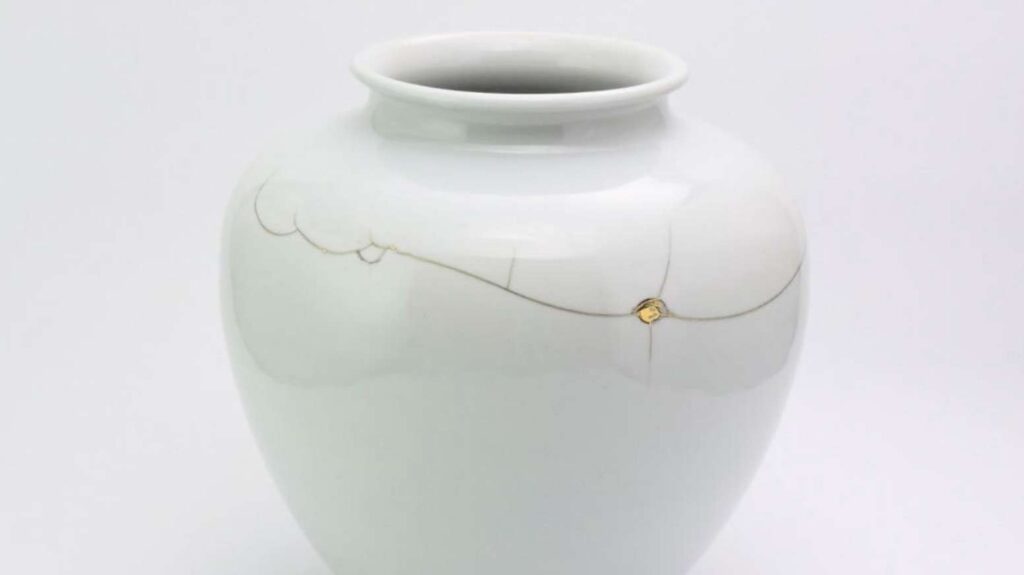
Caption: The first work completed through the CACL project
The crowdfunding initiative “STAND WITH NOTO PROJECT,” launched soon after responding to Omukai’s call for help, grew into a major undertaking thanks to many supporters, ultimately receiving more than 22 million yen from 1,073 contributors.
Through connections from person to person, we were invited to participate in exhibitions and events at various venues in Tokyo, and in April 2024 we exhibited our works at the Salone del Mobile design fair in Milan, Italy. The sincere interest of international audiences filled us with gratitude and gave us hope that the beauty emerging from the fragment-joining project can be shared beyond language and region.
In November, we also exhibited artworks at the exhibition Dancing with All Things — Ecology of Empathy at the 21st Century Museum of Contemporary Art, Kanazawa. Having the opportunity to present our work at a leading art center representing not only Ishikawa but the Hokuriku region felt like a moment in which the intertwining of chance and necessity came together as a culmination.
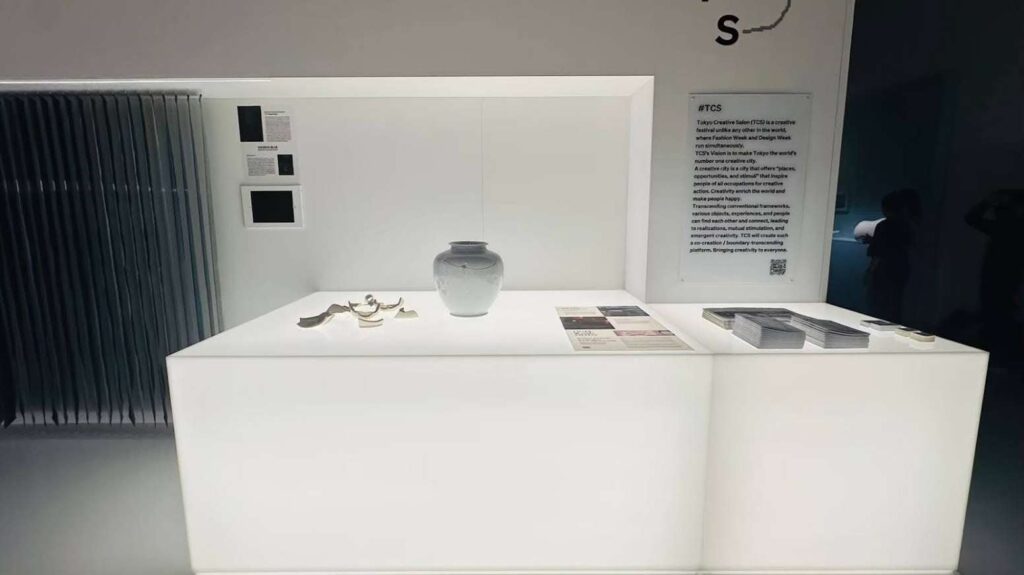
Caption: Exhibition at the Salone del Mobile in Milan
Attending to the Tempo of Others and the Rhythm of Nature
At the same time, bringing together different elements to create new value is far easier said than done, and both the artisans, our staff, and I faced constant difficulties.
One of the greatest challenges was recognizing differences in tempo. Wajima lacquerware involves 124 processes and progresses according to a distinctive rhythm. Because lacquer is a natural material greatly affected by seasonal conditions and humidity, the work can require long periods of waiting, or conversely demands readiness to act at moments that cannot be missed. For someone like me, with an impatient, business-oriented temperament, it took time to fully grasp these characteristics.
Yet in retrospect, I can now say that this experience itself embodies what I wish to question in society.
In industrial production, humans establish rules concerning quality and process and thereby sort out what is considered “out of standard.” The rhythm of lacquer, however, cannot be controlled. Through encountering lacquer artisans as “others,” and confronting nature as something beyond control, I came to experience firsthand a reexamination of what rules are, and for whom they exist.
Naturally, the stress experienced by artisans who had been displaced from their hometown and forced to work in unfamiliar environments must have been immeasurable. They could not use their essential tools, had no colleagues nearby to consult when difficulties arose, and were faced not with their usual wooden bases but with the unfamiliar material of ceramic fragments.
The boundary between friction and co-creation is exceedingly thin, and I cannot express enough gratitude to the artisans who worked to overcome these conditions.
Now they propose new ideas almost every day, which brings me great joy and encouragement. They say, “I want to create a namazu-o kabuto,” or suggest experimenting with ceramic fragments and lacquer finishes, even generating sample images using AI to share their ideas.
At such moments, I feel as though I am witnessing a miracle.
If the disaster had not occurred, Wajima lacquer artisans might never have left their region to work in unfamiliar places. Traditional crafts such as Kutani ware, Suzu ware, and Wajima lacquer might never have encountered one another, collided, merged, and mixed. Art capable of moving people beyond borders and language might never have emerged.
How should we receive a great earthquake that produced many victims and plunged a region into devastation, and how should we carry it forward into the future? Without turning away from sacrifice, anger, or hope, we must continue to think and act.
I believe this is our mission.
Piercing Openings, Joining Fragments, Questioning Society
Through years of involvement in welfare and through leading the fragment-joining project while experiencing the Noto Peninsula disaster, I have gradually come to understand something.
It is the fragility of a society in which notions of “value” and “strength,” which should originally be relative, become fixed.
In the Noto Peninsula Earthquake, many Wajima lacquer artisans lost both their homes and their work. People who had been respected in their communities as “masters” were suddenly forced into difficult lives as disaster victims. Disaster shakes what is considered normal and instantly transforms those who had lived ordinary lives into the vulnerable.
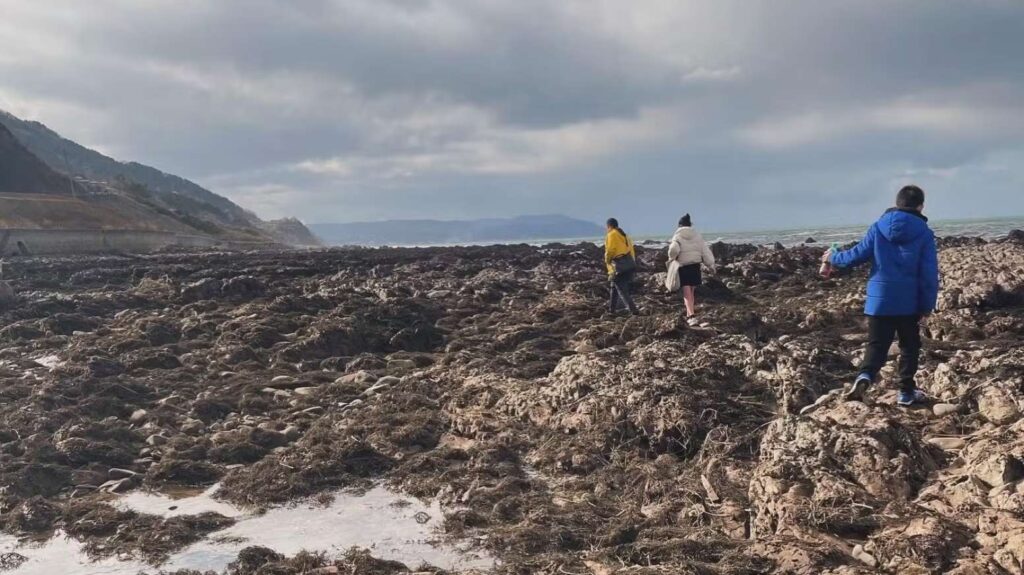
Caption: Omukai’s family walking along the uplifted Noto coastline after the disaster
Yet the true problem lies not in becoming vulnerable, but in the social structures that keep people in that state. A world in which people who acquire disabilities due to accidents or circumstances must live permanently in hardship is unreasonable. For me, it is a society that feels uncomfortable and difficult to find hope in.
I know this: people with disabilities, ceramic fragments, and disaster victims—those excluded from what humans define as “normal”—can take on entirely different colors or become the starting point for new value simply by changing perspective.
However, none of these are complete on their own. What is important is to connect and combine them.
In the welfare field, simply calling for a change in how disability is perceived often proved difficult. Yet when combined with the issue of succession shortages in traditional crafts, it generated employment and markets, expanding the circle of stakeholders. Likewise, the encounter between kintsugi techniques and ceramic fragments following the disaster created new connections.
At the same time, the global reconsideration of economic systems of mass production, mass consumption, and mass disposal—and the growing awareness of environmental issues and the SDGs—also create points of connection with our project. How can ceramic fragments, which are extremely difficult to return to the soil, be reused? We see great potential in collaborations with architecture and materials industries.
This goes far beyond merely securing economic rationality through combination. It can become an opportunity for people to question self-centered assumptions and human-centered social systems.
At the exhibition at the 21st Century Museum mentioned earlier, we displayed all works directly on the floor without using pedestals. We wished to express a worldview in which artworks made of ceramics born from the earth rest on the same plane. Watching visitors kneel to view the works, I felt a quiet hope that even a small opening—a space to question what is considered normal—might emerge.
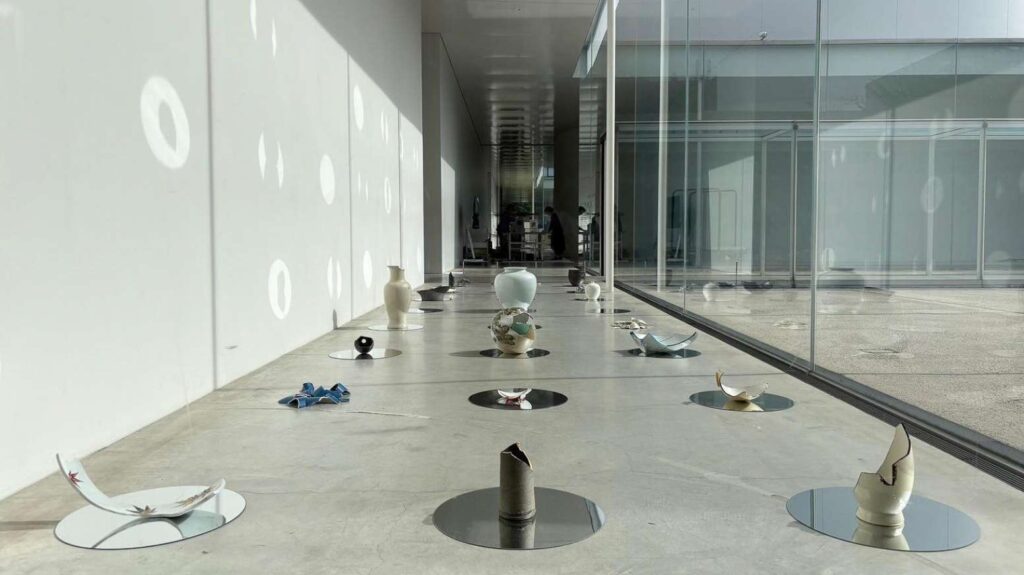
Caption: Installation view at the 21st Century Museum of Contemporary Art, Kanazawa
Moving forward, while building on the knowledge and experience accumulated through the disaster, we hope to pursue collaborations not only among Wajima lacquerware, Kutani ware, and Suzu ware, but also with other crafts within Ishikawa. We also aim to expand our work to include materials, people, and technologies from other regions and countries.
Beyond artworks, everyday objects, and building materials, we plan to develop projects in architecture and spatial and landscape design that incorporate perspectives that question what is considered “normal.”
To be honest, the future is not so clear that it can be expressed in a single statement. The act of turning our attention to the fragments scattered throughout the world and joining them together holds possibilities that exceed our imagination.
Who decides what is “out of standard”?
We will continue to ask this question. Across borders and languages, across methods and fields, we will seek the boundaries between them and create new points of connection. We believe this will open small breaches in the assumptions that bind us and carry the intertwining of chance and necessity toward a better future.
This page has been translated using AI. While every effort has been made to ensure accuracy, please refer to the original Japanese text for the authoritative version.
