Topics お知らせ
CACL Presents “HASHI STAND” and Kintsugi Works to Artists and Major Art Institutions Active in Wartime Ukraine, Through Robert Campbell
October.11.2025
CACL Inc. (Headquarters: Nomi City, Ishikawa Prefecture; Representative Director: Junichi Okuyama), which operates the “Rediscover Project” — an initiative that discovers new value in traditional crafts and off-spec items that might otherwise be discarded — entrusted 40 sets of “HASHI STAND” and kintsugi artworks to Japanologist Robert Campbell, who spent about three weeks this summer visiting several cities in Ukraine to research artistic activities and the situation of artists under wartime conditions.
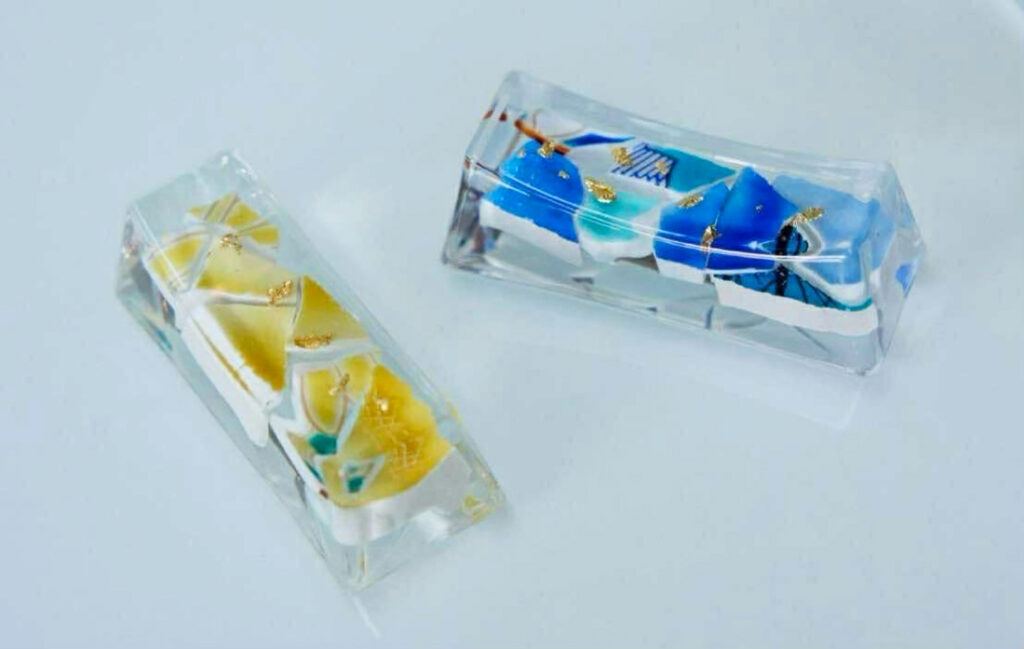
The “HASHI STAND” pieces, purchased by Mr. Campbell through the Rediscover Project, were presented by him to artists and major art institutions active in Ukraine.
Each “HASHI STAND” features a special design made by encasing fragments of Kutani porcelain — in blue and yellow, the colors of the Ukrainian national flag — within transparent resin. The pieces were distributed among local artists and received heartfelt responses such as, “We were deeply moved by this symbol of solidarity and resilience.”
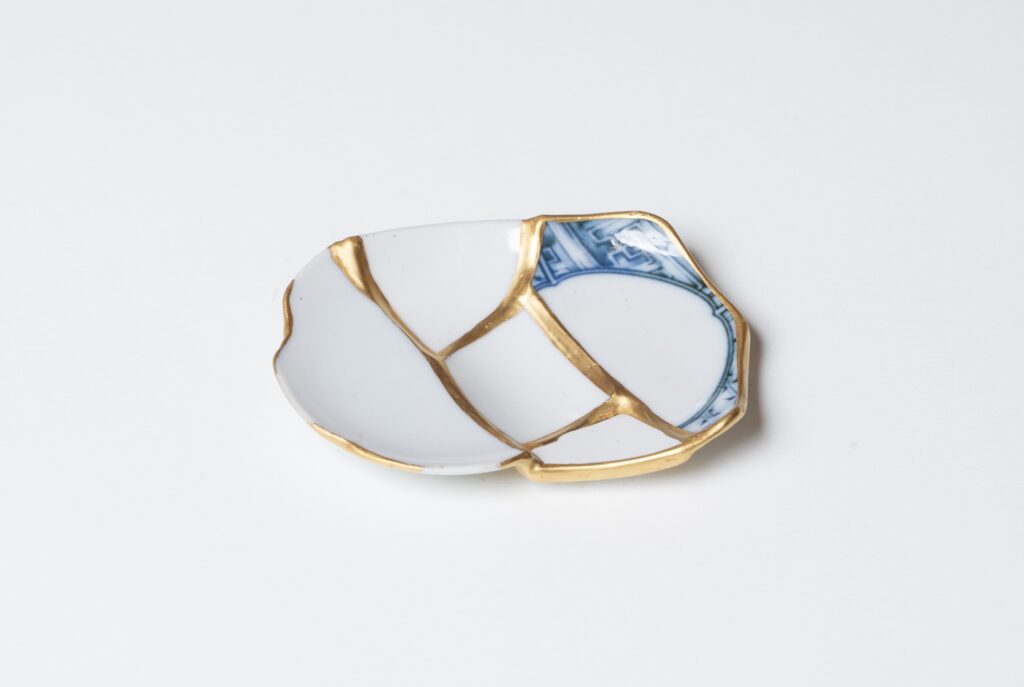
The kintsugi artworks were donated to three key institutions that play an essential role in Ukraine’s art scene.
The first was UNBROKEN, a comprehensive rehabilitation center in Lviv for those injured during the war. At this facility, where art therapy is also practiced, a work was presented to Mr. Anton Kolomieitsev, the city’s Chief Architect. Mr. Kolomieitsev commented, “This beautiful vessel expresses solidarity. I would like to immediately consider a way to display it so that both patients and staff can see it.”
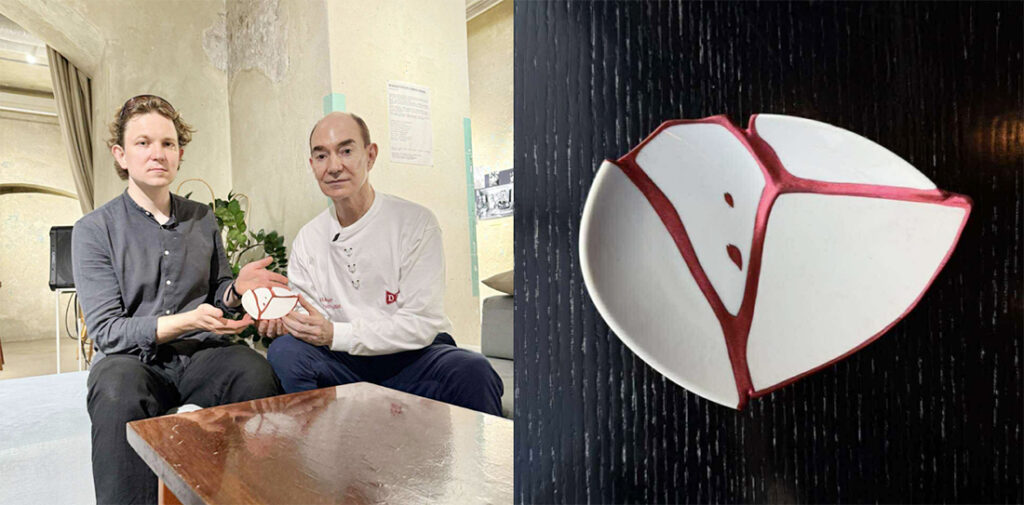
(Left) At “UNBROKEN,” Chief Architect Anton Kolomieitsev (Right) The donated artwork
The second location was the Yermilov Center, a combined shelter and exhibition space that serves as a hub for contemporary art in eastern Ukraine and continues to support artistic activity even during the war. A ceramic plate was presented to Ms. Natalia Ivanova, the center’s Director, who was deeply pleased and expressed her desire to explore future collaborations with Japan.
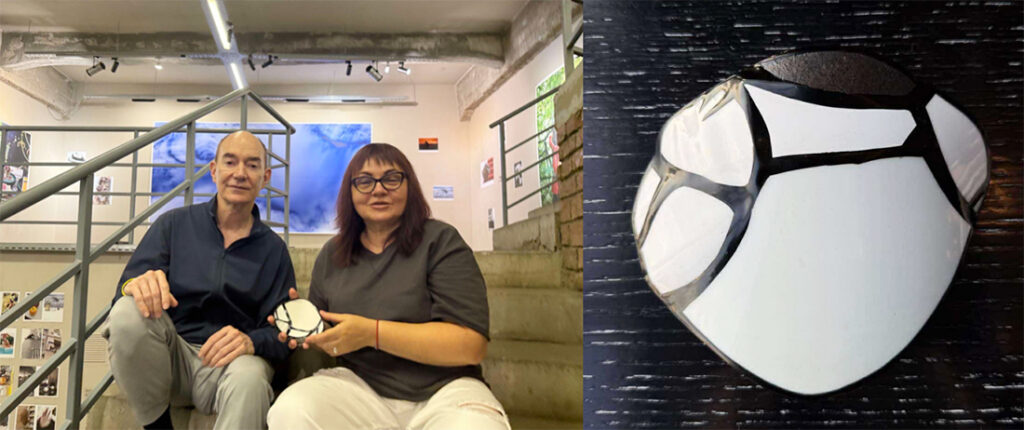
(Left) At the Yermilov Center, Director Natalia Ivanova (Right) The donated artwork
The final destination was the National Art Museum of Ukraine in Kyiv — a place that continued to secretly preserve the works of many artists executed during the Stalinist purges of the Soviet era.
The museum’s General Director, Ms. Yulia Lytvynets, stated that the donated plate would be added to the museum’s collection and that she intended to use it in a future exhibition.
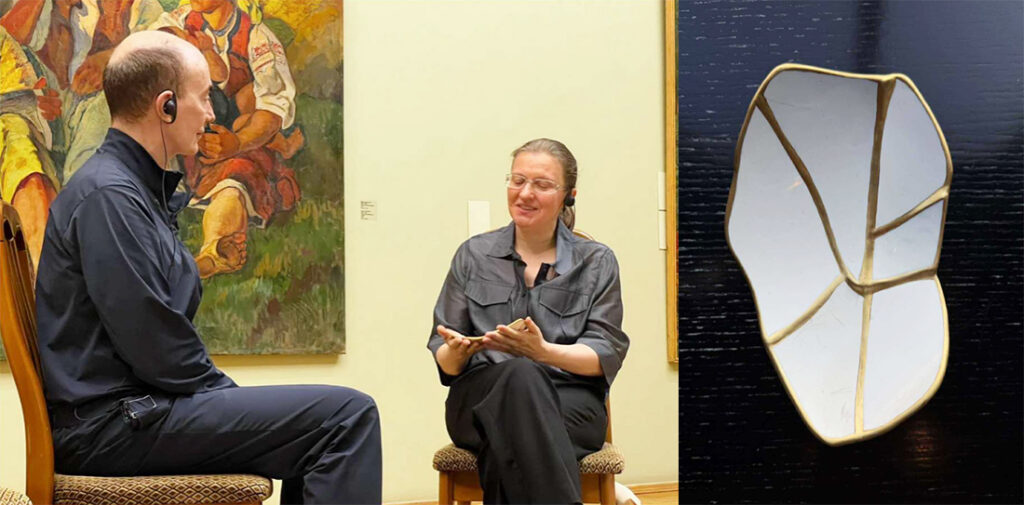
(Left) At the National Art Museum of Ukraine, General Director Yuliia Lytvynets (Right) The donated artwork
With the cooperation of Kyiv-based photographer and multimedia artist Vera Blansh, Mr. Campbell visited a residential building in the city that had been bombed. There, they collected fragments of tableware destroyed in the explosion, which were entrusted to Mr. Campbell to bring back to Japan.
After his stay in Ukraine, Mr. Campbell shared the following reflections about the future of this initiative:
“In Ukraine, where the war continues, not only buildings and infrastructure but also many people’s bodies and minds have been deeply wounded. To remain Unbroken—to continue living without breaking—requires many kinds of support, and among them, the power of art is being increasingly recognized. From rehabilitation sites to the destroyed cityscapes and even the spaces where children learn, art serves as testimony, as record, and as a living medium that connects people.
When the people of Ukraine held the colors and shapes of the beautifully restored fragments born from the Noto Peninsula earthquake, they needed little explanation—they intuitively understood and were moved. I strongly hope to continue nurturing this emotional bond, kindled through disaster, together with CACL and the people of the affected regions.”
Through continued collaboration with Mr. Campbell, CACL aims to explore new creative expressions that connect the fragments born from war with those born from the Noto earthquake—building artistic works that symbolize solidarity between the two regions beyond national borders.
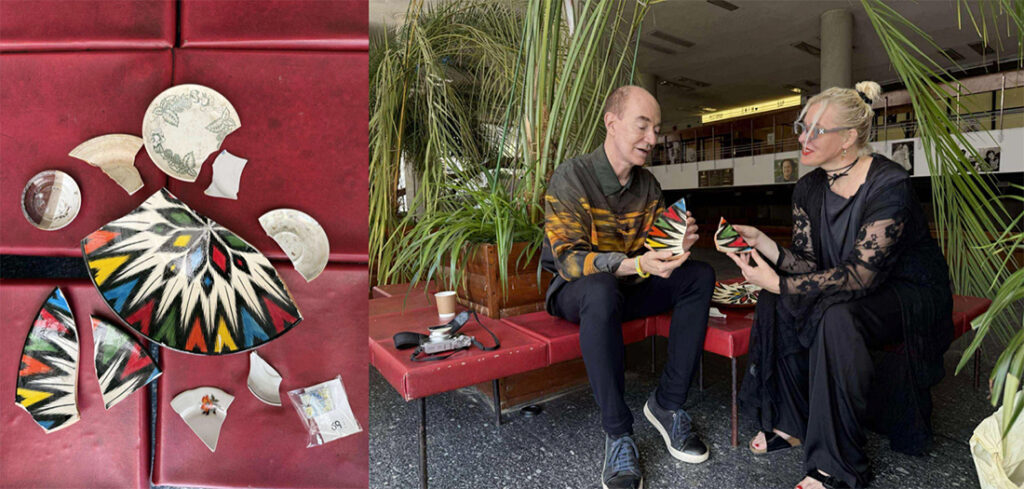
(Left) Fragments of tableware destroyed by the explosion (Right) Photographer and multimedia artist Vera Blansh, who cooperated in the “fragment exchange”
Comment from Junichi Okuyama, Representative of CACL
“I had long been hearing from Mr. Campbell about the situation in wartime Ukraine, and while searching for something meaningful we could do, I realized there was a natural connection with our own activities. Ukraine continues to live under the unreasonable circumstances of war, where people survive each day on the edge between life and death. In Noto as well, recovery from the earthquake will take time.
By exchanging ceramic fragments born from such harsh environments, I felt this could become an activity that carries significance for both sides. The broken cups and plates Mr. Campbell brought back still bear traces of mud and dust—remnants of the people who lived there just before the impact. I intend to spend time with these fragments, to reflect, and to explore how they might be expressed through our work.
One day, I hope that this will lead to exchanges between artists in Ukraine and those in Ishikawa, allowing them to inspire and influence one another.”
About CACL
CACL Inc., based in Nomi City, Ishikawa Prefecture — a region renowned for its Kutani ware — is a company that addresses two intertwined social challenges: the shortage of artisans to carry on traditional crafts, and the limited employment opportunities and low wages faced by people with disabilities. By combining these issues, CACL develops initiatives that create solutions benefiting both sides.
The company has been producing art pieces and products made by reconnecting fragments of ceramics. In response to the 2024 Noto Peninsula Earthquake, CACL launched the Stand with NOTO project as part of its reconstruction support efforts, establishing temporary workshops for Wajima lacquerware artisans and creating new job opportunities. Building upon this, CACL initiated the evolved art project Rediscover Project, which incorporates fragments of Suzu ware and the techniques of Wajima lacquer into Kutani ceramics. Artworks created from ceramic fragments damaged in the earthquake were exhibited at the 21st Century Museum of Contemporary Art, Kanazawa, in the exhibition Dancing with All – The Ecology of Empathy.
In July 2025, CACL established KAKERA, an experimental brand exploring the redefinition of value in traditional crafts and off-spec materials through the creation of new products and materials using ceramic fragments. The brand has collaborated with Parfums Givenchy, and together with LIXIL and Yuko Nagayama & Associates, launched a joint project aimed at preserving and reimagining Noto’s traditional landscape for the future.
Company Information
Company Name: CACL Inc.
Website: https://cacl.jp/
Address: Ri-56 Tatsunokuchi-machi, Nomi City, Ishikawa Prefecture 923-1245, Japan
Representative: Junichi Okuyama
Established: June 1, 2023
Tel: +81-761-48-8004